
How to Choose a Brand Activation Company in Las Vegas
The right brand activation company does more than build something attractive. It delivers an experience that works when it matters most. Discover what to look for in a partner, with lessons from six years of designing the competition apparatus for the MLS All-Star Skills Challenge.
November 19, 2026
Brian Chapin
Planning an event in Las Vegas comes with no shortage of competition for attention. From major conventions and trade shows to product launches and experiential events, brands have to create experiences that stand out in a crowded environment.
Choosing the right brand activation company can make a significant difference. The right partner should do more than produce an attractive installation. They should understand your objectives, translate your brand into an engaging experience, and have the technical capabilities to make that experience work when it matters.
To show what that looks like in practice, this guide draws on one of Production Theory's longest-running programs: the custom competition apparatus we have designed and built for the MLS All-Star Skills Challenge every year since 2021.
Start With Your Objectives
Before evaluating companies, define what you want your activation to accomplish. Are you generating leads, launching a product, increasing brand awareness, creating social content, entertaining an audience, or giving customers an opportunity to experience your product firsthand?
Clear objectives give your activation partner a framework for developing the creative concept, audience journey, technology, and measurement strategy.
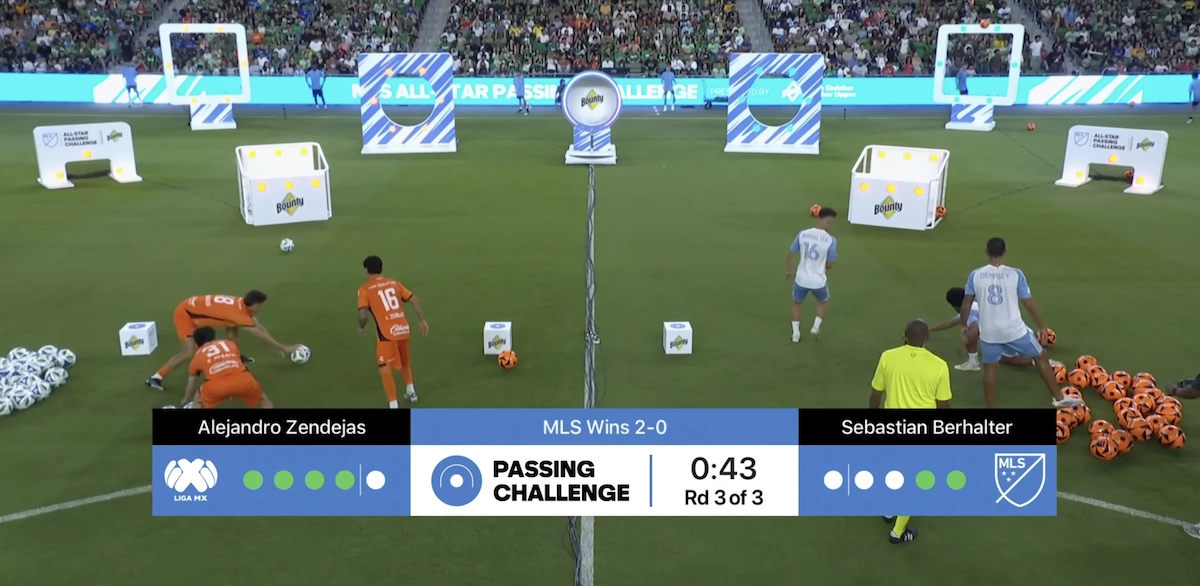
When Major League Soccer first approached Production Theory, the brief was specific. MLS identified the player skills it wanted to showcase and asked us to turn them into five original pieces of apparatus where MLS All-Stars and visiting teams could compete head-to-head. The games needed to be competitive, fair and entertaining for spectators. That clarity made it possible to design every mechanism around a defined outcome, and it is the kind of starting point any brand can create before talking to partners.
Look for Relevant Experience
Experience matters, but relevant experience matters more.
Review potential partners' portfolios and look for projects similar to yours in scale, audience, venue, or complexity. A company that understands large conventions may approach a consumer-facing pop-up differently than a firm focused primarily on smaller installations. Pressure matters too. A build that will be used by thousands of guests, filmed for broadcast or run for several days straight needs a partner that has designed for those conditions before.
Ask how involved the company was in previous projects. Did they handle design, fabrication, installation, and production, or were those responsibilities divided among several vendors? It also helps to know what kind of company you are talking to. Brand activation marketing agencies often manage the full event, bringing in A/V, travel, talent and convention services. Design and fabrication partners like Production Theory focus on the physical experience itself, and often work directly alongside those agencies and brand teams.
Finally, look for repeat clients. A single strong project shows capability. A program that keeps coming back shows a partner that delivers. The MLS partnership completed its sixth consecutive year in 2026, growing from the original five games to apparatus for six challenges, including a new Relay Challenge between MLS and LIGA MX.
Evaluate Creative and Storytelling Capabilities
A successful activation should feel like an extension of your brand, not a generic event installation with your logo added at the end.
Look for a partner that can develop creative concepts around your brand story and audience. Strong experiential design considers how attendees enter, move through, interact with, and remember the space.
For MLS, the story was the athletes. Each challenge was built to put a distinct soccer skill on display: shooting accuracy under time pressure, controlling incoming balls, crossing and volleying, precision passing and striking the crossbar. Because the gameplay and the apparatus were developed together, the equipment itself tells the story of what makes these players exceptional.
Technology can also support the experience through interactive displays, digital content, QR-based experiences, gamification, and other engagement tools. The technology should serve the concept rather than become the concept.
Consider Fabrication and Production Capabilities
Creative ideas have to work in the real world.
Custom brand activation fabrication requires careful attention to materials, engineering, structural requirements, finishes, installation, transportation, and venue limitations. A partner with in-house or closely integrated fabrication and production capabilities can help reduce the disconnect between what is designed and what is ultimately built.
The MLS Skills Challenge is a clear example of why this matters. The apparatus is used by professional athletes in live competition, broadcast to an international audience. By 2026, the event was available through Apple TV in more than 100 countries and regions. A missed target response or stalled mechanism would interrupt the broadcast and compromise the competition, and a target that behaved inconsistently could change the outcome.
Our team spent hundreds of hours researching and developing how the equipment would function, producing proprietary moving, drop and retracting target systems built to deliver the same response throughout every challenge. Through TheoryLab, the research and development side of Production Theory, that kind of engineering happens alongside fabrication in our Las Vegas shop.
When comparing companies, ask how they test their builds and what happens if something fails on-site. The answer will tell you a lot about their production quality.
Discuss Budget, Scope and Timeline Early
A strong creative concept still needs to fit the budget.
Ask potential partners for clarity around design, fabrication, transportation, installation, technology, labor, and other production costs. Understanding the full scope early can help prevent unexpected expenses later.
The cheapest proposal isn't necessarily the best value. Consider the quality of execution, capabilities included, communication, and level of support you're receiving.
Timeline belongs in this conversation too. In the first year of the MLS program, Production Theory had just 90 days from early concept development to delivery. In that window, our team worked out how five different games would function, developed their apparatus and completed fabrication. Aggressive timelines can be met, but only when a partner is honest up front about what the schedule requires.
Ask How Success Will Be Measured
Your activation should have measurable objectives.
Depending on the campaign, useful metrics might include qualified leads, attendance, product interactions, samples distributed, social engagement, user-generated content, website traffic, viewership or conversions.
The right brand activation services partner should be willing to discuss measurement before the event, not simply report attendance afterward. They should also be able to explain how the physical design supports your goals. In the MLS Skills Challenge, competition is the engagement: head-to-head formats, timed races and clear scoring give fans something to follow and react to.
Pay Attention to Communication
Large experiential projects involve many moving parts. Creative development, approvals, fabrication, shipping, venue requirements, installation, technology, and event schedules all have to stay aligned.
Ask who will manage your project, how often you'll receive updates, and how changes are handled.
Communication is also what keeps long-term programs growing. Each year of the MLS partnership has brought new ideas to the table, and the 2026 Relay Challenge combined elements of the existing skills competitions into a new timed team format. That kind of evolution only happens when both sides trust the process.
Choosing the Right Activation Partner
Ultimately, the best activation partner is one that fits your brand, objectives, working style, and expectations.
For brands comparing brand activation marketing agencies and production partners in Las Vegas, look beyond the portfolio. Find a team that can connect storytelling to design, engineering, fabrication and dependable execution.
At Production Theory, we bring designers, engineers, fabricators, and project managers together in Las Vegas to turn ambitious concepts into physical experiences for events nationwide, from custom brand activations to TheoryLab builds with moving parts and live gameplay.
The right partner doesn't just help you create something people will see. They help you build something people will remember.
Brian Chapin
SEE MORE ABOUT AUTHOR



Follow Us

