
A Guide to Choosing Experiential Design Firms in Las Vegas
Plenty of experiential design firms can present a compelling concept, but fewer can engineer, test and build it to perform in the real world. Learn what to evaluate before you hire.
October 28, 2026

Brian Chapin
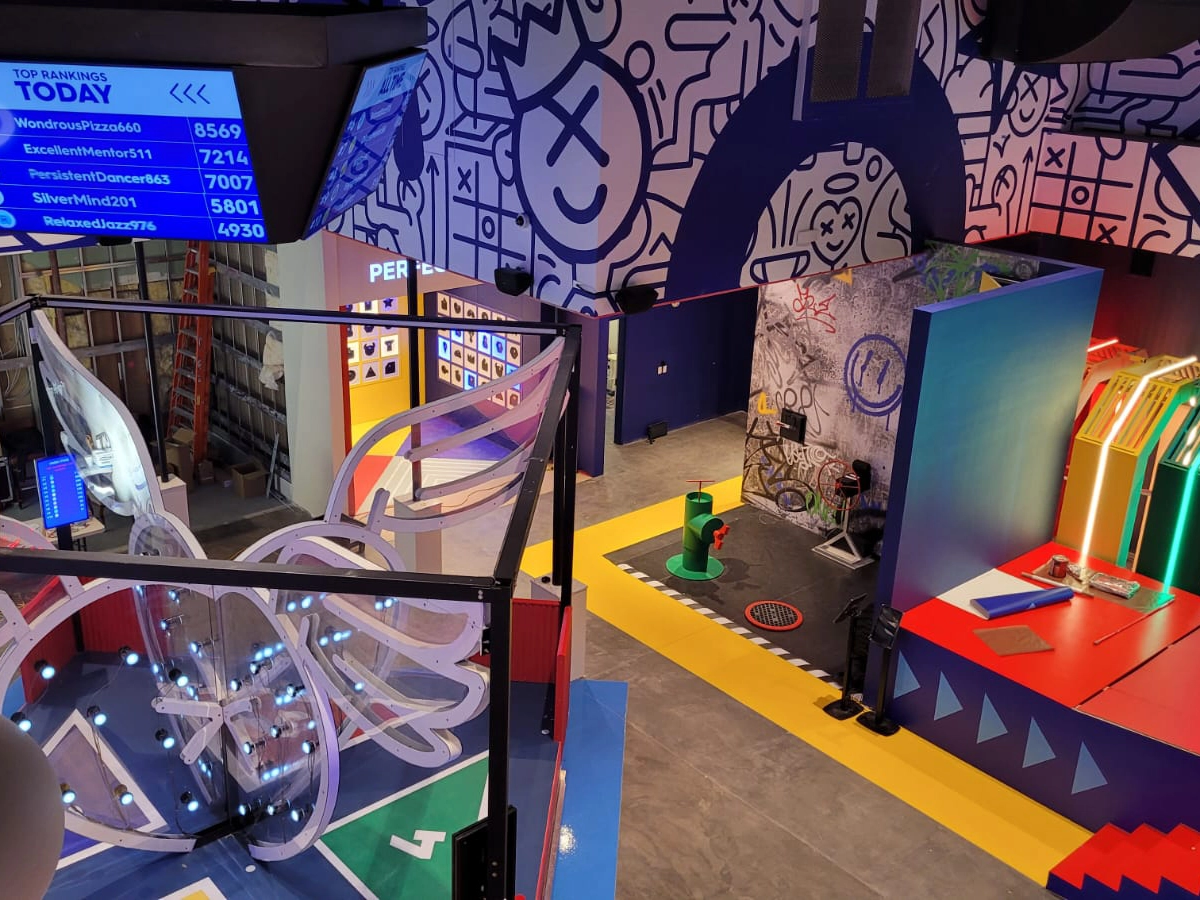
Las Vegas is full of experiences competing for attention: trade show floors, hotel attractions, product launches, corporate events and permanent entertainment venues. In a city like Las Vegas, a strong idea is not enough. The experience has to work, every time, for every guest who walks up to it.
That is what makes choosing among experiential design firms difficult. Plenty of companies can present a compelling concept. Fewer can engineer it, build it, test it and install it so it performs in the real world.
To make the evaluation more concrete, this guide uses one of our own Las Vegas projects as a running example: Play Playground at the Luxor Hotel and Casino, where Production Theory co-created, engineered, fabricated and installed seven original physical games for a permanent attraction.
1. What Are Experiential Design Firms?
Experiential design is the practice of creating environments and interactions that let people engage with a brand, story or space directly, rather than just looking at it. Experiential design firms create things like immersive installations, branded environments, interactive games, trade show exhibits and attractions.
The range inside that category is wide. Some experiential design companies focus on concept and visual direction. Experiential graphic design firms often specialize in environmental graphics, signage, wayfinding and branded surfaces. Others, like Production Theory, lead with design and fabrication, carrying a concept through engineering and production into a finished, working build.
Knowing which kind of firm you need is the first decision.
2. Understand Your Objectives, Including How Long the Experience Has to Last
Before contacting potential partners, define what the experience needs to accomplish and who it is for. Are you launching a product, entertaining guests, encouraging repeat visits or creating social content?
Also define the lifespan. A three-day activation and a permanent attraction are very different projects. Play Playground's brief called for games that were fun, competitive and built for permanent public use. That single word, permanent, shaped every decision that followed, from materials to electronics to testing.
Clear objectives give firms what they need to propose the right approach, and give you a way to judge their answers.
3. Review Their Portfolio and Ask About Their Exact Role
Portfolios show what a firm has been part of. They don't always show what the firm actually did. Ask for specifics on each project: Did they develop the concept? Design the space? Engineer the mechanics? Fabricate? Install?
Large experiences are often collaborations, and clear roles are a good sign. At Play Playground, Bishop established the aesthetics and visual concept of the surrounding space. Production Theory co-created the game concepts and handled engineering, fabrication and installation of the games themselves. Each firm brought a different strength, and the division of work was clear from the start.
A firm that can explain its role precisely is usually a firm that understands where its expertise begins and ends.
4. Look for End-to-End Capabilities on the Hard Parts
An idea is only as good as its execution, and the hardest parts of an interactive experience are usually invisible to the guest.
Take Perfect Popper, one of the Play Playground games. Players race the clock to place shapes into matching positions. It looks simple. Behind it is a technical assembly combining electromagnetic technology, piece detection and an extensive LED wiring system, so the game knows when a piece is in place and lights the corresponding space instantly.
When comparing firms, ask whether their own team engineers and builds the technical systems behind an experience, or whether that work is handed off to outside vendors after the design is approved. Creative development, 3D design, engineering, electronics integration, fabrication, project management and installation all need to connect. When they sit with one team, problems get solved in the shop rather than discovered on opening day.
5. Evaluate Their Las Vegas Experience
Las Vegas projects come with their own logistics: casino and hotel properties, convention centers, union requirements, tight install windows and venues that never really close. A firm with local experience can anticipate those constraints before they become problems.
Play Playground was installed inside the Luxor, bringing the completed game systems into their permanent home on the Strip. As a Las Vegas-based design and fabrication partner, Production Theory builds here regularly, and also delivers projects nationwide.
6. Consider Technology and Interactive Experiences With a Purpose
Technology should make the experience better, not just more complicated. The right question is not "what technology do you use?" but "why does this experience need it?"
At Play Playground, every sensor had a job tied to gameplay:
- Ringer Run uses soundwave sensor technology as players guide a ring along a twisting course without touching the sides.
- Doctor! Doctor! uses proximity sensing and RFID so the game responds as players reassemble a larger-than-life character.
- High Five tests reaction speed with illuminated targets players race to strike.
- Stomp It and the other games extend the range from careful placement to fast reactions.
Across the collection, the games also connect to the attraction's software and an integrated leaderboard, turning physical play into shared competition. That required thousands of hours of research and development so that every physical action produced the intended response, consistently.
Through TheoryLab, our research and development side, this is the kind of work we focus on: physical interactions engineered to feel intuitive.
7. Ask How They Prototype and Test
This is the question many brands forget to ask, and it is one of the most revealing. How does the firm know the experience will hold up?
For Play Playground, durability was a starting point, not an afterthought. Our prototyping focused on safety, functionality and durability while keeping each game fun and competitive. We used the equipment the way we expected guests to, including high-stress testing designed to expose weaknesses before installation. UL-listed components were used throughout the complete game assemblies.
A firm that can describe its testing process clearly is far more likely to deliver an experience that works on day one and day 500.
8. Compare Timeline, Communication and Budget
Cost matters, but the cheapest proposal is rarely the best value. Ask each firm to break down what is included: design, engineering, materials, fabrication, technology, transportation, installation and support.
Ask for a realistic timeline too. Play Playground took 12 months from concept development to opening. Once concepting was complete, Production Theory had five months to build and deliver seven games, each with its own technical requirements. A strong partner will be honest about what a schedule allows and how it will be managed.
Communication ties it together. Look for clear milestones, defined approvals and a single point of contact who understands both the creative and technical sides.
Questions to Ask Before Hiring an Experiential Design Firm
- What parts of the project do you handle in-house, and what do you subcontract?
- What exactly was your role on the portfolio projects you are showing us?
- Who engineers the mechanics and electronics behind interactive elements?
- How do you prototype and stress-test before installation?
- Is the experience being designed for a single event or long-term use?
- Have you worked in our Las Vegas venue, or one like it?
- How do you handle changes during production?
- What is included in the budget, and what is not?
Choosing the Right Experiential Partner
The best experiential design firms don't stop at a compelling rendering. They understand how the experience has to behave, who will use it and how hard they will use it, and they have the engineering and production capability to deliver it.
Production Theory is a Las Vegas-based experiential design and fabrication partner working nationwide. Through TheoryLab, we take interactive concepts through research, prototyping and production into finished experiences people can physically engage with. If you are planning an experience in Las Vegas or beyond, we would like to hear what you have in mind.
Brian Chapin
SEE MORE ABOUT AUTHOR



Follow Us

